Before we dive in, I want you to think about what you feel is the biggest reason why your clear aligner treatment is not going as well as it should. There are a lot of factors here, and you’re probably going down a list in your head right now (hating the company doesn’t count, FYI).
Over the last 1,500+ aligner cases that I have treatment planned and treated, I have given this an unreasonable amount of thought, and while I don't believe that we can blame it simply on one factor, I do believe that there is a BIGGEST factor — so here it is, folks: staging.
That's it. That's the one.
If you've planned enough of these, you probably already knew this, but maybe you haven't quite figured out yet how to either standardize it, build consistency or streamline the process. If you don't think that's what it is, you probably haven't planned enough cases yet.
I've had the great fortune not only of treating thousands of aligner patients in my career, but also teaching and reviewing many cases of others. The most common error that I have seen by far, even in my own cases, is that the way teeth are designed to move from start to finish (T1 to T2) does not always occur as it needs to for optimal effectiveness or efficiency with aligners.
Most of us know how we want the teeth to look at the end of our design, following the principles we can all agree on regarding occlusion, anterior-posterior tooth position, smile arc, torque, buccal corridors, gingival display and some other important details like micro and mini-esthetics. What many of us don't get right often enough is the specific method in which force is applied to teeth, the directions in which it is applied and the order in which those movements occur.
The order is arguably the most important of these three. The two most common culprits are: (1) failure to develop and use proper protocols, or the far more frustrating (2) attempting to communicate what is designed in your head via text, only to get back something that appears as though it makes no sense to you.
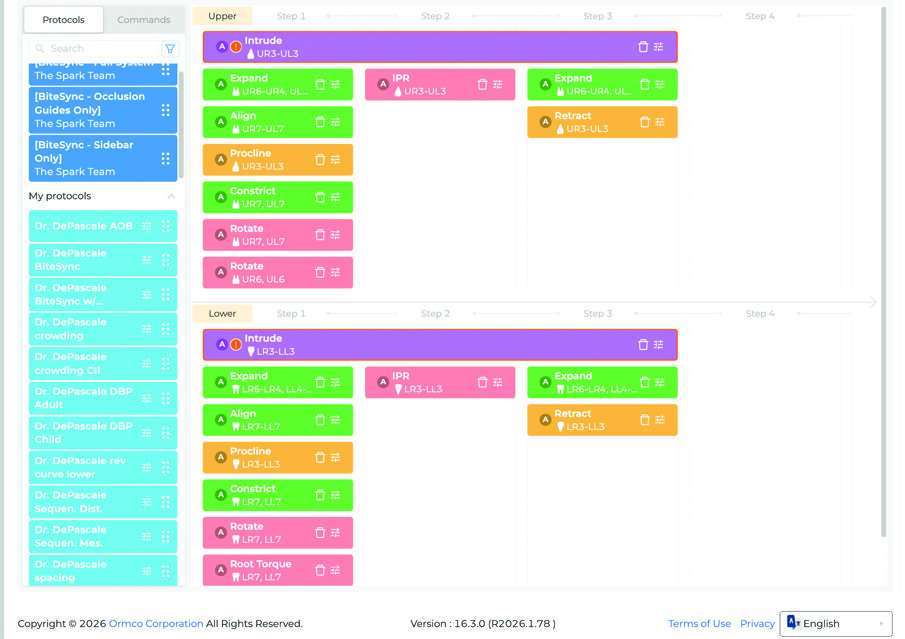
Ormco recognized this, and that is precisely why there now exists a system to help solve this problem. That system is called StageRx (Fig. 1). This is a visual, drag-and-drop workflow that uses command blocks, customized to your design protocols, to communicate directly with the technician helping design your cases.
Fig. 1: StageRx. (All photos provided by Dr. Mike DePascale)
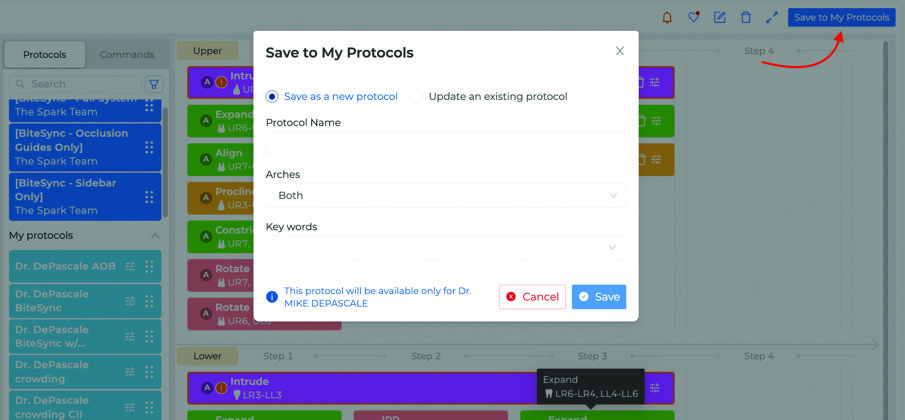
Fig. 2: Rename an existing protocol.
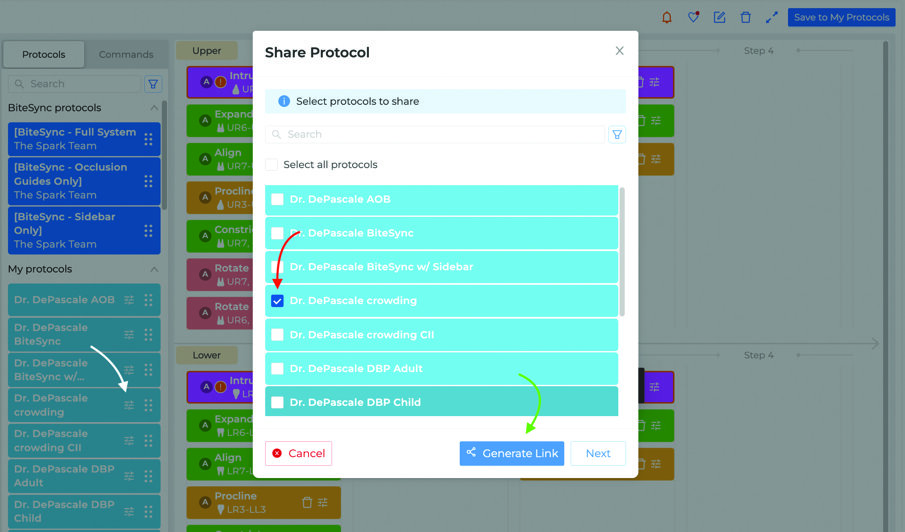
Fig. 3: White arrow to share, red arrow to select which to share, green to generate link to send.
Dr. Mike DePascale completed his orthodontic master's degree at the University of Maryland in Baltimore and is a partner at Kozlowski DePascale Orthodontics in New Jersey. One of Spark's founding offices, he is passionate about clear aligner innova-tion, efficiency and education. Outside the practice, you'll find him in his garage gym or coaching CrossFit — putting his commitment to growth and community to good use.
You no longer have to write out exactly how you want a tooth or teeth moved; you can worry less about the phrasing or word choices and how they might be interpreted — or misinterpreted; and you can hopefully spend far less time behind the screen while providing even better treatment than you did before.
Spark has a series of protocols built into the platform already. If you're a newer user, you have those at your disposal as a foundation that you can later customize. If you're an advanced user looking to level up your cases but spend more time fishing or with your family, you're going to like this even more. You can set up cases exactly how you wish and quickly apply them while submitting a case, or even delegate the task to a team member without worrying about the wording or process failing you.
In addition to the ease of submission and standardization, there are a few other added benefits.
First, these protocols are completely customizable on the spot. You can add specific notes to each case. You can save a protocol at any point. You can edit one whenever you'd like. All you have to do is edit, rename an existing protocol or save a new one, hit save, and you're done (Fig. 2). You've just changed your preferences. Sometimes I do this because of something I learn or notice while designing a case.
Second, you can share them with other doctors. Have a friend that needs help setting up a case? Send your protocol to them and let them use it as a guide. Want to teach others your methods? Share the protocols with a group and follow up with discussion afterward (Fig. 3).
And lastly, because of their generosity, some of the top aligner doctors in the world have made their protocols publicly available, so there is an endless amount to be learned here as well.
My favorite part of this new system, though, is not what it is right now — it's what it can and will be. As it stands, StageRx aims to provide a solution to the most irritating problem in aligner treatment: getting the setup to look how you want.
Because let's face it, as much as most of us absolutely love what we do and how we get to make people smile, who wants to spend 20 hours a week planning it behind a computer? And who loves it when treatment doesn't go as planned for a second, or third, or fourth time, and now we're in refinement four or five with a frustrated doctor and patient?
Would anyone NOT want to accomplish the same amount of work in half, or one-third or one-quarter of the time? You might think that's not possible, but I do. I believe that is where we are headed.
Some time in the future, I believe we can take this to a place where the software uses your submitted data and records — photos, PAN/CEPH or CBCT, and protocols — creates a setup in minutes that you can approve in minutes and generates aligners in — fill in the blank — days? Hours? The possibilities are endless, but right now, at the very least, it will improve your communication, collaboration, case design and treatment outcomes by providing clarity, consistency and predictability.
I think we can all agree that is a beautiful thing — for our own lives and for our patients' lives.
Editorial note:
(Disclaimer: Ormco, a medical device manufacturer, does not dispense medical advice. Clinicians should use their own professional judgment in treating their patients. Dr. DePascale is a paid consultant for Ormco. The opinions expressed are those of the doctor.)
Topics:
Tags:
Anterior open bites present orthodontists with a unique challenge: achieving successful and timely treatment while minimizing patient inconvenience. ...
Which is better: a horse or a car? While at first it seems like this is a silly question that most can easily dismiss, this question can prompt endless ...
Live webinar
Thu. 15 October 2026
10:00 AM EST (New York)
Live webinar
Thu. 15 October 2026
1:00 PM EST (New York)
Live webinar
Thu. 15 October 2026
2:00 PM EST (New York)
Dr. John Tsourounakis DDS, Cert. Perio, MS, FRCD(C)
Live webinar
Thu. 15 October 2026
2:30 PM EST (New York)
Dr. Varkha Rattu, Cat Edney
Live webinar
Fri. 16 October 2026
5:00 AM EST (New York)
Prof. Dr. Dr. Florian Stelzle
Live webinar
Mon. 19 October 2026
1:00 PM EST (New York)
Live webinar
Mon. 19 October 2026
1:00 PM EST (New York)



 International / International
 Brazil / Brasil
 Canada / Canada
 Latin America / Latinoamérica
 Austria / Österreich
 Bosnia and Herzegovina / Босна и Херцеговина
 Bulgaria / България
 Croatia / Hrvatska
 Czech Republic & Slovakia / Česká republika & Slovensko
 France / France
 Germany / Deutschland
 Greece / ΕΛΛΑΔΑ
 Hungary / Hungary
 Italy / Italia
 Netherlands / Nederland
 Nordic / Nordic
 Poland / Polska
 Portugal / Portugal
 Romania & Moldova / România & Moldova
 Slovenia / Slovenija
 Serbia & Montenegro / Србија и Црна Гора
 Spain / España
 Switzerland / Schweiz
 Turkey / Türkiye
 UK & Ireland / UK & Ireland
 China / 中国
 India / भारत गणराज्य
 Pakistan / Pākistān
 Vietnam / Việt Nam
 ASEAN / ASEAN
 Israel / מְדִינַת יִשְׂרָאֵל
 Algeria, Morocco & Tunisia / الجزائر والمغرب وتونس
 Middle East / Middle East

 Dr. Sinan GhishanRegister now1CELive webinar
 Dr. Sonia PresenciaLive webinar
 Dr. John Tsourounakis DDS, Cert. Perio, MS, FRCD(C)Register now1CELive webinar

 Dr. Varkha Rattu, Cat EdneyRegister now1CE















To post a reply please login or register